Automist vs. Traditional Sprinklers: What’s Best for ADUs?
If your ADU project has triggered a fire sprinkler requirement, you have two main options: a traditional NFPA 13D sprinkler system, or Automist. Here’s what each involves.
Installation
Traditional sprinklers require a network of rigid piping routed through ceilings and walls, with multiple sprinkler heads distributed throughout the space. This typically involves opening ceilings and coordinating pipe routing with other building services.
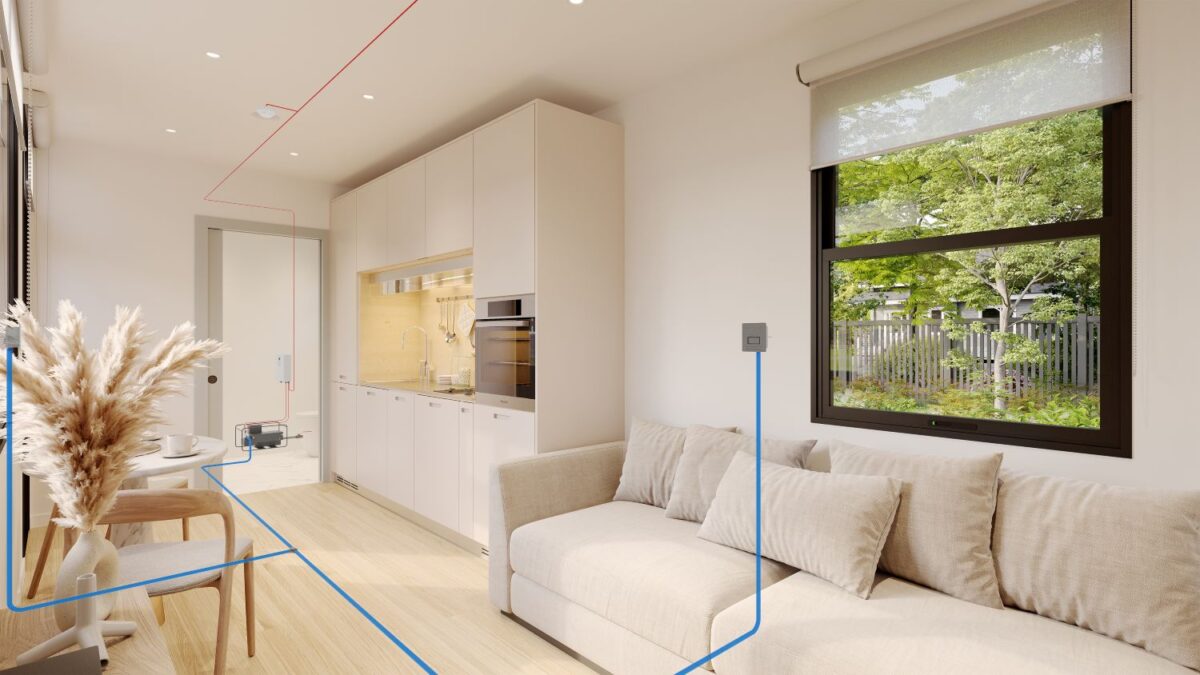
Automist uses a small number of wall-mounted spray heads connected by flexible PEX hose to a compact pump unit (9″ × 7″ × 14″ — fits under a sink). There is no ceiling pipework.
The use of flexible hose is important. Unlike rigid pipe, PEX can be routed through existing cavities, around obstacles, and within tight spaces without requiring straight runs. This significantly reduces the need to open up finished walls or ceilings and allows installation to follow the building rather than forcing the building to accommodate the system.
Water supply
Traditional 13D sprinklers typically require 13–26 GPM, which often means upgrading your water meter ($2,000–$5,000) and possibly the supply lateral (~$20,000). Automist needs only 2.4 GPM — it connects directly to a standard ¾” domestic cold water line. No meter upgrade, no new tap, no storage tank.
Water damage
If a traditional sprinkler activates, it releases a large volume of water. Automist uses approximately 90% less water, limiting collateral damage to a fraction of what a conventional system would cause.
Aesthetics and retrofit
Automist’s wall-mounted heads are discreet. Because the system uses flexible hose instead of rigid pipe, it is particularly well suited to retrofit and ADU projects where ceilings are already finished, structural members cannot be easily penetrated, space is limited and build efficiency and repeatability is a priority.
Disclaimer: This information is not intended to be a comprehensive guide to all of the aspects of the building/fire code but rather a useful source of background information. Whilst every care has been taken to ensure that the contents of this post are correct at the time of publication, it should never be used as any form of substitution for the full NFPA® codes, standards, recommended practices, and guides. It should be noted that there may be specific additional requirements dependent upon the Authority Having Jurisidiction (AHJ).
Yes — Automist can be used as an alternative to an NFPA 13D fire sprinkler system in domestic occupancies, where permitted by the local Authority Having Jurisdiction (AHJ). Automist is not an extinguishing system; it is a fire suppression system that is specifically designed and Listed for domestic use, meeting the intent of NFPA 13D sprinkler protection.
Learn moreTo ensure your Automist system is installed correctly and complies with all necessary standards, it must be fitted by a trained installer. In the US, we recommend choosing from our network of trained installers who are familiar with the system’s unique design and requirements. You can find our official list of approved installers here.
This ensures you receive a professional installation and the peace of mind that your Automist system will perform as intended.
Learn more